
MIM – Metal Injection Moulding

Mass production of precision metal components without compromising on geometry or material properties.
Enquire about a part
MIM vstřikolis

What is MIM

MIM (Metal Injection Moulding) combines the design freedom of plastic injection moulding with the mechanical properties of metals. The result is small, complex-shaped components with a density of over 95% of the theoretical value, dimensional tolerances of ±0.3% of the nominal dimension and a surface roughness of Ra 2.0 μm – straight from the manufacturing process, without the need for costly finishing machining.

MIM technology is the economically sound choice where CNC machining reaches its geometric limits, capacity constraints or rising unit costs, and where conventional casting fails to meet the required tolerances or surface finish.

How MIM works

The process begins with the feedstock – a homogeneous mixture of fine metal powder (particles smaller than 20 μm) and a polymer binder. This mixture is injected into a mould in the same way as plastic. The result is a so-called ‘green part’, which has a compensated geometry.

The binder is then removed chemically or thermally (debinding), producing what is known as a ‘brown part’, which undergoes sintering in a furnace at a temperature of 1200–1400 °C in a protective atmosphere. During sintering, the metal particles fuse together by diffusion to form a compact whole – shrinkage of 15–25 % occurs and the material’s density exceeds 95 % of the theoretical value.

The result: a metal component with properties comparable to those of machined steel, produced in runs of thousands at a fraction of the cost of machining.

MIM components

From small safety mechanisms to precision surgical instruments. MIM enables the production of parts that either could not be manufactured at all using conventional methods, or would be several times more expensive. We will adapt your part for MIM – from assessing its suitability, through mould design, to series production.

Contact us
MIM díly

The MIM manufacturing process

Six steps from powder to the finished part. Every single one takes place under our own roof.

1. Preparation of the feedstock

Metal powder with spherical particle morphology up to 20 μm is mixed with a polymer binder system – a primary binder (paraffin waxes, polyoxymethylene, etc., to ensure fluidity) and a secondary binder (polypropylene or polyethylene to maintain shape during depolymerisation). The binder system accounts for approximately 40% of the mixture’s volume. The homogenised mixture is extruded and subsequently granulated, producing the feedstock for the MIM process

We develop our own feedstock – the composition is selected according to the specific application and the customer’s material requirements.

Available material groups
Group Typical alloys Characteristics
Low-alloy steels 4140 (DIN 1.7225), ČSN 15 142 High strength, hardenability
Stainless steels 316L, 17-4PH (DIN 1.4542) Corrosion resistance, biocompatibility
Tool steels M2 (DIN 1.3343), ČSN 19 830 Hardness, wear resistance
Titanium alloys Ti-6Al-4V Strength/weight ratio, biocompatibility
Superalloys Inconel 718, CoCr Heat resistance, high-temperature strength

2. Injection moulding

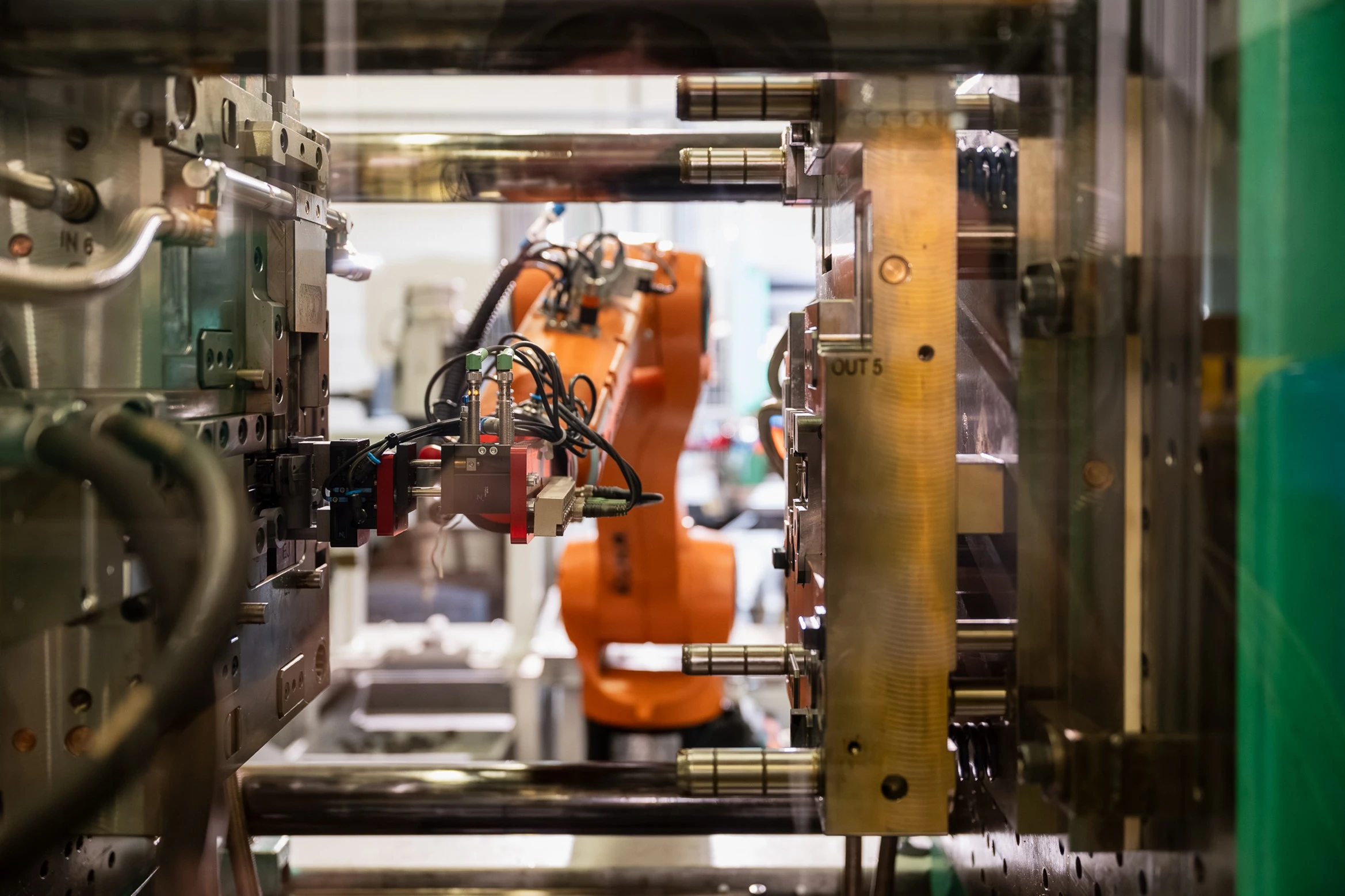
The feedstock is plasticised and injected under pressure into a precision metal mould. The machines are similar in design to plastic injection moulding machines, but adapted to cope with the abrasive nature of the metal powder. The moulds are deliberately oversized by 15–25 per cent to compensate for shrinkage during sintering.

The resulting green part has precise, compensated geometry – internal/external threads, undercuts, blind holes, thin walls from 0.4 mm, ribs and markings. All in a single injection.

3. Debinding – removal of the binder

The binder accounts for 30–40 % of the volume and must be removed without altering the dimensions of the part. We use three methods depending on the composition of the binder:

  • Catalytic debinding – depolymerisation in a nitric acid atmosphere; proceeds from the surface at a constant rate, minimising internal stress
  • Solvent debinding – selective removal of the wax component using a chemical bath; opens the pores for subsequent heat treatment
  • Thermal debinding – controlled evaporation of the residual binder at a precisely controlled rate of temperature rise

The result is a brown part – a porous, brittle part that retains the shape and size of the green part.

4. Sintering

The brown compact is sintered in a controlled-atmosphere furnace (nitrogen, hydrogen, argon or vacuum) at 1200–1400 °C. At 80–90 % of the metal’s melting point, atomic diffusion takes place: metal particles coalesce and pores are sealed.

Isotropic shrinkage to the final dimensions takes place. Material density: ≥ 95% of the theoretical value. Dimensional tolerance in the modern process: ±0.3% of the nominal dimension.

After sintering, the component has mechanical properties comparable to those of forged material – this is the key difference compared to piston pressing, which achieves only 85–90 per cent of the density.

5. Post-processing

Most MIM parts emerge from the sintering process in their final form – a surface roughness of Ra 2.0 μm and dimensional accuracy of ±0.3 % generally meet customer requirements without the need for further processing.

Where there are specific requirements for higher precision, higher strength or other surface properties, we offer:

  • Machining of precision functional surfaces
  • Thermal and chemical-thermal treatments – heat treatment, annealing, nitriding, carburising, carbonitriding
  • Surface treatments – passivation, electroplating, PVD, DLC coatings, controlled oxidation
  • Tumbling and sandblasting to achieve a specified surface roughness or meet aesthetic requirements

6. Quality control

Each batch undergoes dimensional inspection, metallographic analysis of the structure, and strength and hardness tests. For parts of a higher criticality, we carry out non-destructive testing to detect internal porosity.

The entire process chain is managed in accordance with the ISO 9001 standard. The company’s quality policy is primarily focused on the customer and their individual needs. Every component is traceable from the powder batch right through to dispatch.

Where MIM delivers results

MIM is not suitable for every component. However, when the conditions are met – in terms of geometric complexity, material strength and production volume – it proves to be a better option, both economically and technically, than any alternative.

Advantages over CNC

Design freedom that CNC cannot offer. Internal threads, blind holes, undercuts, thin walls from 0.4 mm – all in a single injection moulding cycle, without the need for re-clamping or the assembly of individual components. MIM allows multiple functions to be integrated into a single part.

Density ≥ 95%

Density and strength comparable to those of forged material. Density ≥ 95 % of the theoretical value. Unlike piston pressing (85–90 %), MIM achieves properties that can be used in structural calculations without the need for correction factors for porosity.

Dimensional accuracy

Dimensional accuracy of ±0.3% across the entire series. Once the mould has been fine-tuned, MIM produces hundreds of thousands of identical parts with minimal variation. This forms the basis for reliable assembly and predictable performance of the part in its application.

Efficiency ≥ 95%

Lower unit cost for medium and large production runs. The material efficiency of MIM technology exceeds 95 per cent. Compared with CNC machining, where a significant proportion of the material ends up as swarf, MIM produces only minimal waste. In the CNC machining of expensive alloys, up to 80 per cent of the material is lost as swarf. For complex parts in runs of approximately 1,000–2,000 pieces, MIM becomes more cost-effective than machining – and the advantage increases further as production volumes rise.

No polishing

Surface finish Ra 2.0 μm without further machining. MIM parts generally do not require further surface finishing. Precision casting typically achieves a surface finish of Ra 3.2 μm and requires finishing. MIM eliminates this step.

Compatibility with HIP

Compatibility with HIP. For applications with the most demanding fatigue strength requirements, we offer post-HIP treatment using our own equipment. The density approaches 100% of the theoretical value. For nickel superalloys (e.g. Inconel 718), the fatigue life following HIP is increased by a factor of 4–5 compared with standard heat treatment.

MIM or another technology?

The choice of manufacturing method depends on the part’s geometry, the batch size and the material. Below are the key comparisons that will determine the choice.

MIM vs. CNC machining

CNC requires no initial investment and offers high precision for simple shapes. However, the cost per unit rises linearly with the complexity of the part – every recess, internal cavity or, for example, rib increases the number of set-ups and machining time.
With MIM, the cost of the mould is a fixed initial expense. Once the mould is in place, the unit cost depends on the weight rather than the complexity of the geometry.

Break-even point: for a complex part with internal features, approximately 1,000–2,000 pieces per batch. For a simple shape, up to 12,500 pieces. Above this volume, MIM is cheaper – and the advantage increases as the volume rises.

MIM vs. investment casting

Parameter MIM Precision casting
Surface finish (Ra μm) ~2.0 ~3.2
Tolerance ±0.3 % ±0.5 %
Optimal weight up to 100–250 g over 250 g
Surface finish not usually necessary usually required

For parts weighing up to 250 g where precision and surface finish are required, MIM is consistently superior. Above this weight, the cost of fine MIM powders becomes uncompetitive compared to casting materials.

MIM vs. traditional powder metallurgy (PM pressing)

Piston pressing achieves a density of 85–90 per cent and does not allow for parts with undercuts or parts with varying wall thicknesses along a single axis. MIM does not have these geometric limitations and achieves a density that is 7–12 percentage points higher. For structurally stressed parts with complex geometries, powder metallurgy pressing is not a comparable alternative.

Parameter Value
Density after sintering ≥ 95% of the theoretical value
Dimensional accuracy ± 0.3% of the nominal dimension
Surface roughness Ra 2.0 μm or better
Sintering shrinkage 15–20 % (isotropic)
Part weight 0.1–500 g
Maximum dimension up to 250 mm
Annual production volume 5,000 – 500,000 pcs
Tolerances in accordance with standard ISO 2768-mK
Wall thickness (min.) from 0.4 mm

Who uses MIM technology?

Companies that require small metal components with precise geometry, defined mechanical properties and repeatability, in quantities ranging from thousands to hundreds of thousands of pieces per year.

The automotive industry

Variable valve timing system components, locking mechanisms, connectors, control elements. Production runs of tens of thousands of units; IATF 16949 compliance required.

Defence industry

Trigger mechanisms, safety catches, stops, latches. Precise geometry and repeatability are essential here, not merely an advantage.

Healthcare

Surgical instruments for laparoscopy, orthopaedic fasteners, dental components. Biocompatible alloys (316L, Ti-6Al-4V), sterilisable surfaces, disposable multi-purpose instruments.

Electronics and Electrical Engineering

Shielding covers, connector housings, sensor housings. Dimensional accuracy and the ability to miniaturise to under 1 gram are key parameters.

Industrial equipment

Gear segments, sliding components, pump parts, valve components. Tool steels and low-alloy steels, heat treatment tailored to the application.

Watchmaking and Precision Engineering

Micro-components with tolerances in the micrometre range, with a surface requiring no further machining.

Typical components produced using MIM technology

  • Retaining clips, latches, pins
  • Precision gear segments and planetary gears
  • Sensor housings and connector bodies
  • Hinge and connecting elements
  • Surgical clips, forceps, instruments for minimally invasive surgery
  • Safety and trigger mechanisms
  • Functional microcomponents for mechanical assemblies weighing from 0.1 g

Why Vibrom?

Development and production of feedstock

We tailor the composition of the mixture to the material requirements of the application. We collaborate with the Czech Academy of Sciences on the development of new material systems.

In-house mould manufacturing

We design, manufacture and modify the moulds ourselves. Direct control over precision, service life and deadlines. No intermediary between design and production.

HIP using our own equipment

We carry out isostatic hot pressing in-house. For applications requiring maximum fatigue strength or the elimination of internal porosity, no external collaboration is required.

Everything under one roof

Heat treatment, surface finishes, secondary machining – all carried out in-house. Shorter lead times, a single point of responsibility for the entire component.

ISO 9001

Each batch is documented from the batch of input material right through to the final inspection.

Design to cost

We are involved in the design of the part to eliminate unnecessary costs even before the mould is manufactured. Changing the geometry in a PDF is inexpensive; changing it in the mould is not.
Find out what’s new