| Parameter | Value |
| Operating temperature | 800–2,000 °C (typically 1,100–1,250 °C for steels) |
| Operating pressure | 100–200 MPa (isostatic) |
| Working medium | Argon (inert atmosphere) |
| Achievable density | ≥ 99.9% of the theoretical value |
| Dimensional change after HIP | depending on the porosity of the input material |
| Cycle duration | 8–24 hours (including heating and controlled cooling) |
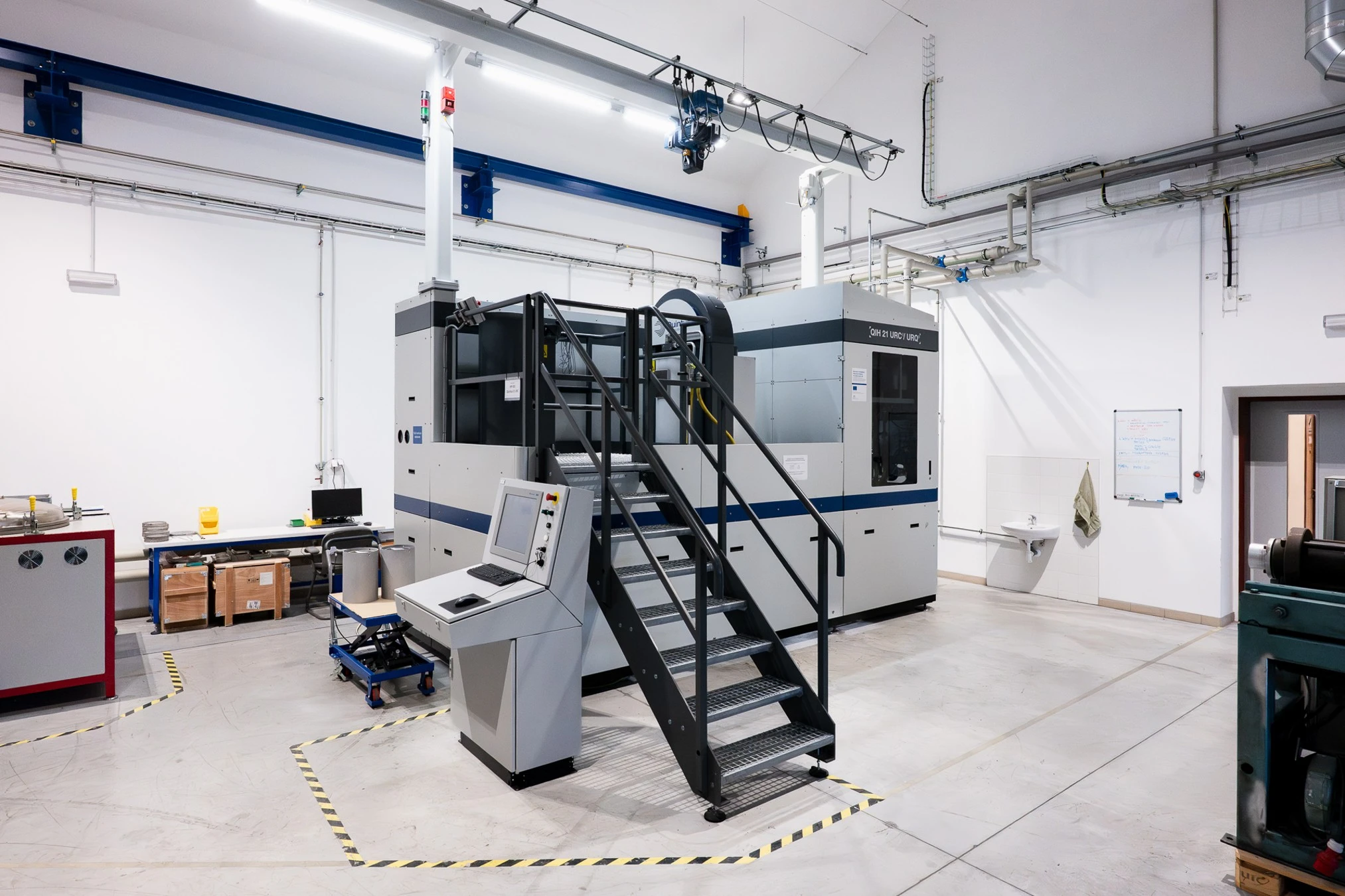
| Equipment | Quintus QIH 21 (in-house) |
| Material compatibility | Steels, titanium, nickel/cobalt superalloys, ceramics, cermets |
| PM HIP – maximum part weight | depending on the equipment |
| Heat treatment in a cycle | Possible (combined HIP cycle and others) |
| Process certification | AMS 2801, AMS 7000, ASTM F3122, EN 9100 |
| Batch traceability | From raw material to HIP cycle report |
HIP – Hot Isostatic Pressing
Isostatic hot pressing – elimination of porosity, maximum material density.

The HIP process, step by step
Six steps from powder to the finished part. Every single one takes place under our own roof.
1. Receipt and incoming inspection of parts
Each part enters the process accompanied by documentation detailing the material batch. We carry out a visual inspection, a dimensional analysis and a density measurement.
2. HIP cycle proposal
Based on the material, geometry and the customer’s application requirements, we design the cycle parameters: temperature, pressure, dwell time, and heating and cooling rates. We work with certified cycles whilst also developing our own sets of parameters for non-standard alloys.
Commonly used material groups for HIP treatment:
| Material group | Typical alloys / materials | Typical applications |
| Low- and medium-alloy steels | 4140 (DIN 1.7225), ČSN 15 142 | Machine parts, moulds, forgings |
| Stainless and duplex steels | 316L, 17-4PH, 2205 | Chemical industry, healthcare |
| Tool steels | M2, H13, ČSN 19 830 | Moulds, cutting tools, cylinders |
| Aluminium alloys | AlSi10Mg, AlSi7Mg, AlSi12 | Castings, aerospace components |
| Titanium alloys | Ti-6Al-4V, Ti-6Al-2Sn-4Zr-2Mo | Aerospace, healthcare, motorsport |
| Nickel and cobalt superalloys | Inconel 718, 625, Waspaloy, CoCr | Aviation engines, turbines, medicine |
| Ceramics and cermets | Al₂O₃, ZrO₂, Si₃N₄, WC-Co | Cutting inserts, ballistic protection |
3. Placing in the autoclave
The parts are placed on loading beams and loaded into the pressure chamber of the Quintus QIH 21 unit. The chamber capacity and loading flexibility allow batches ranging from single parts to hundreds of parts to be processed at once. Parts made from different materials can be combined in a single load, provided that the cycle compatibility conditions are met.
4. The HIP cycle
Once the autoclave has been hermetically sealed, the following takes place:
- A controlled increase in temperature according to a defined profile
- Pressurisation to working pressure (100–200 MPa) using argon
- Holding at the working temperature and pressure (typically 1–4 hours)
- Controlled cooling in accordance with the material’s heat treatment
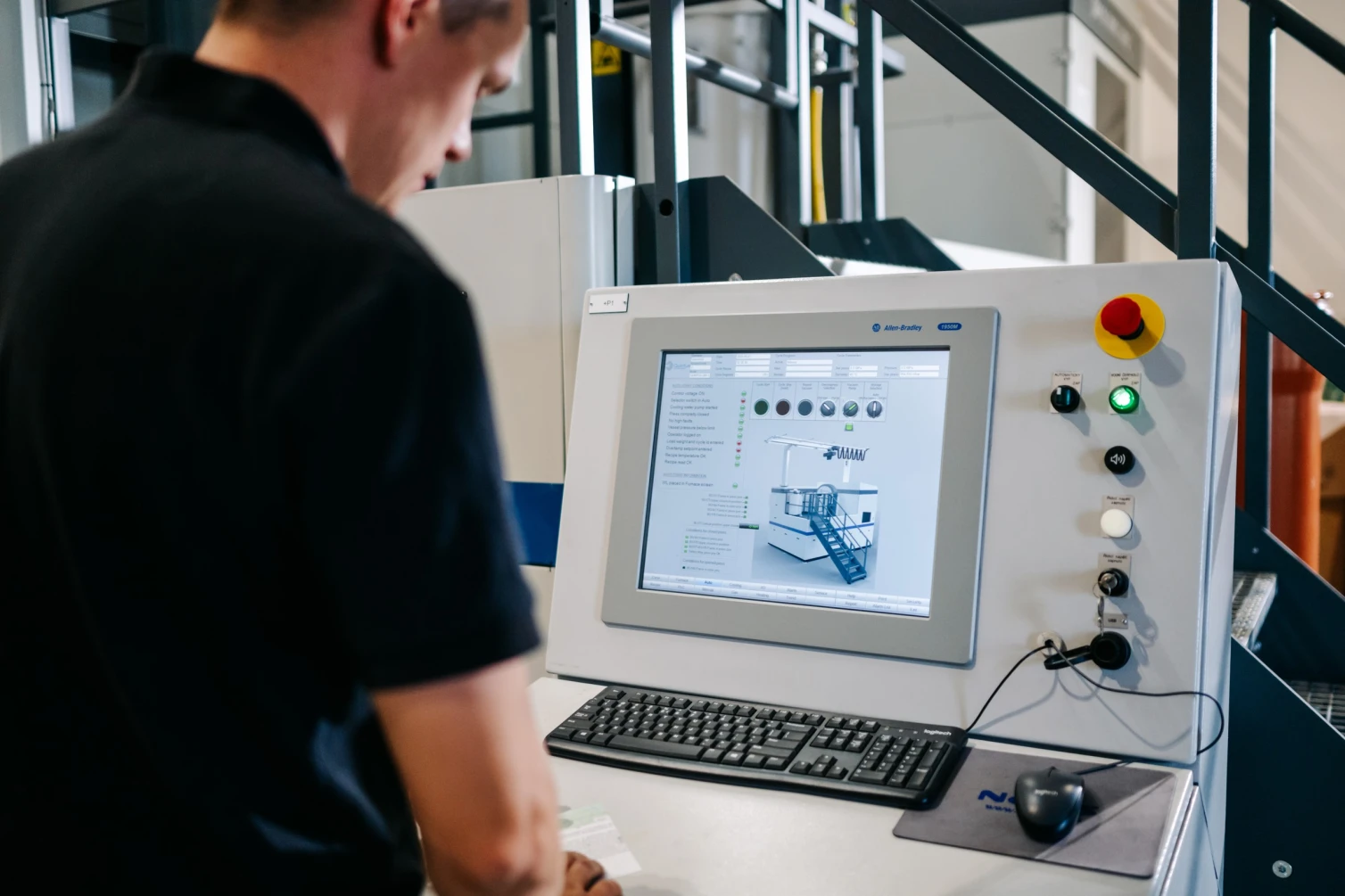
The HIP process is controlled by a control system that monitors and regulates the temperature, pressure and time profile of the entire cycle. Thanks to this control, precisely defined properties of the final product can be achieved.
5. Final inspection
Following the HIP cycle, it is possible to carry out dimensional analysis, determine density and, for critical applications, also perform metallographic analysis and defectoscopy to detect surface and subsurface defects, or determine mechanical properties on test specimens from the same batch.
6. Post-processing and dispatch
We can provide – in the same way as for MIM – a complete post-processing service:
- Machining of precision functional surfaces
- Thermal and chemical-thermal treatments – heat treatment, ageing, nitriding
- Surface treatments – passivation, PVD, DLC, electroplating
- Non-destructive testing and certification in accordance with customer standards (AMS, ASTM, EN)
Where HIP delivers results
The greatest benefits of HIP are seen in materials and technologies where closed pores are formed (casting, MIM, PM, AM) and in critical applications where internal defects are a limiting factor on service life.
Purity 99.9%
Standard sintering in MIM achieves 95–98 % of the theoretical density. The remaining 2–5 % consists of closed pores, which are preferred sites for the initiation of fatigue cracks. HIP eliminates these defects by diffusion sealing – the resulting microstructure is compact, homogeneous and virtually free of internal porosity detectable metallographically.
Density ≥ 95%
Density and strength comparable to those of forged material. Density ≥ 95 % of the theoretical value. Unlike piston pressing (85–90 %), MIM achieves properties that can be used in structural calculations without the need for correction factors for porosity.
4–5 times greater strength
Fatigue strength 4–5 times higher than with standard heat treatment. For nickel superalloys (Inconel 718) and titanium alloys (Ti-6Al-4V), certified material tests show a 4–5-fold increase in fatigue life following HIP treatment compared with parts that have undergone heat treatment alone. For aerospace and medical applications, this is a key parameter, not merely a marketing claim.
Compatibility
Compatibility with MIM, powder metallurgy (PM) compaction and precision casting. HIP is a finishing process that is widely applicable across various manufacturing technologies. It can be used for parts produced using MIM, powder metallurgy (PM compaction), precision casting and additive manufacturing (SLM/LPBF). In all cases, internal defects are sealed and mechanical properties are improved.
Processing of ceramics and cermets
HIP is not exclusively a metallurgical process. Ceramic components (Al₂O₃, ZrO₂, Si₃N₄) and cermets (WC-Co) achieve higher flexural strength and crack propagation resistance following HIP treatment. Applications include ballistic protection, cutting inserts, bearings and medical implants.
Reduction in variance
Reduction in the variation of mechanical properties – lower safety factors. HIP eliminates the so-called ‘scatter band’ – the variation in mechanical properties caused by an inhomogeneous internal structure. A designer working with a HIP-treated component can apply lower safety factors and design a lighter component without compromising reliability. For applications in the aerospace and medical sectors, this is a direct economic and weight-saving advantage.
Diffusion bonding (HIP cladding)
Diffusion bonding (HIP cladding) – bimetallic components without welds. HIP enables two different materials to be bonded together through diffusion – for example, a layer of corrosion-resistant Inconel or Stellite onto a low-cost carbon steel core. The bond is formed without a heat-affected zone, without the risk of cracks and without the use of filler material. The resulting strength of the joint is higher than that achieved with conventional weld overlay. Typical applications: pipe fittings, pumping components for the chemical industry, tool coatings on dies.
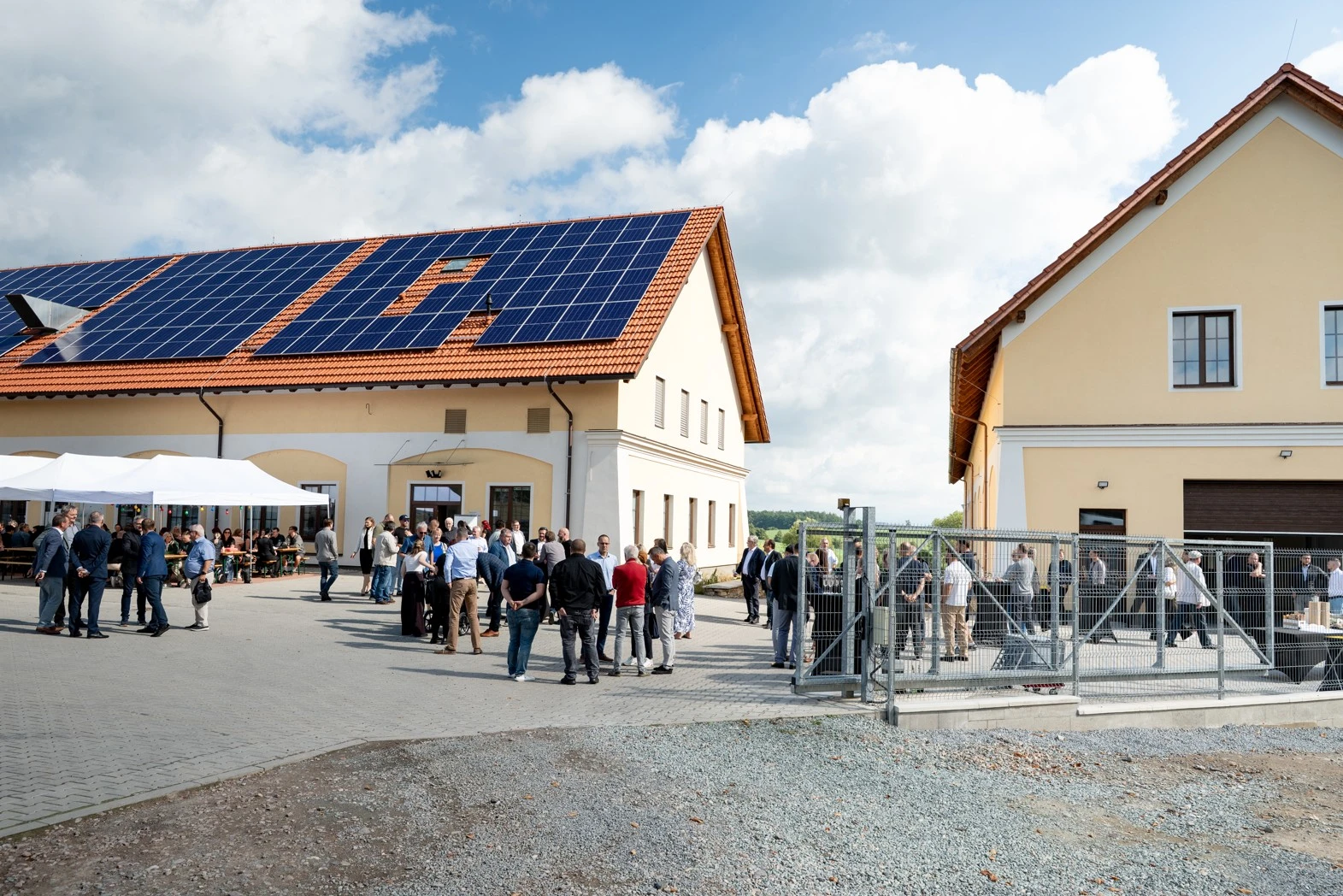
VIBROM operates a Quintus QIH 21 HIP system in-house. The customer does not have to worry about selecting an external supplier, transporting parts or uncertainty regarding delivery times.
Examples of HIP technology


Comparison table – HIP vs. the main alternatives
| Parameter | HIP (completion) | PM HIP | Standard TZ | Fittings | Impregnation |
| Sealing of internal pores | yes | Yes | no | no | surface only |
| Improvement in fatigue strength | +300–400 % | high | no | medium | no |
| Isotropy of properties | absolute | absolute | high | medium | no |
| Geometric stability | depending on the porosity of the input material | Near-net shape | yes | machining required | yes |
| Material utilisation | ~90 % | ~90 % | ~100% | ~60–70 % | ~100 % |
| Tolerance | ±0.1% | ±0.1% | - | ±0.5 % | - |
| Suitability for ceramics / cermets | yes | no | no | no | no |
| Achievable density | ≥ 99.9% | ≥ 99.9% | 95–98 % | 99%+ | ~95% (surface) |
| Max. part weight | depending on the equipment | depending on the machine | unlimited | unlimited | unlimited |
Why Vibrom?
Our own Quintus QIH 21 HIP equipment – in-house
We carry out isostatic hot pressing in-house, using our own industrial equipment. The customer does not need to worry about finding an external partner or arranging the transport of parts to a third party. Delivery times are under our control.
The complete MIM → HIP process chain
For customers who have us manufacture MIM parts, HIP is a natural next step requiring no external collaboration. We take full responsibility for the final part – from the feedstock through to the HIP protocol and the final certificate.
Certified cycles and the development of custom parameters
We work with certified HIP cycles in accordance with AMS and ASTM standards. At the same time, we develop our own sets of parameters for non-standard alloys in collaboration with research institutions – including the Czech Academy of Sciences.
Defectoscopy and full batch documentation
Each batch is documented: temperature and pressure logs, dimensional measurements before and after processing, and metallographic analysis of a representative sample. For aerospace and medical applications, we carry out X-ray or ultrasonic non-destructive testing as a standard part of the process.
ISO 9001
Traceability from the batch of input material through to dispatch. The quality management system covers the entire process chain. Every component is identifiable throughout the entire manufacturing process.
Design to cost
We are involved in the design of the part to eliminate unnecessary costs even before the mould is manufactured. Changing the geometry in a PDF is inexpensive; changing it in the mould is not.
What you might find interesting about HIP
HIP is economically viable when internal porosity significantly affects the performance or reliability of a component. Typical examples include: components subjected to cyclic or dynamic loading (fatigue), components for the aerospace or medical industries, and castings made from superalloys or titanium alloys.
CIP operates at room temperature and is used to compact powders prior to sintering – it is a forming process, not a method of eliminating internal porosity. HIP combines heat and pressure to seal defects by diffusion – it is applied to parts that have already been sintered or cast.
Yes. The combined HIP cycle (HIP + solution annealing + ageing) is the standard approach in the aerospace industry. It saves one heat treatment and ensures uniform properties throughout the entire component.